I was asked for the notes of the Peppa Pig theme tune. As this is one of the most frequently heard tunes in my house at the moment, this was not a problem!
Actually, it’s quite a neat tune for teaching. Ideal for beginning harmonising a tune with chords, as it only uses two (I and V), it’s in C, it’s short and everyone loves Peppa Pig.
It will be a welcome addition or alternative to London Bridge, Ode to Joy and the chorus of Yellow Submarine as an easy two chord tune that everybody knows. (If you have other good ones, please share!)
Once they’ve mastered the concept of changing from C to G and back in root position to suit the tune (they can play the chords while you play the tune at first), I introduce playing G in 1st inversion, so the left hand doesn’t have to leap around. The first step into a world of possibilities.
It is also a good tune for showing how melodies are formed by the harmony underneath them. The melody here completely consists of the notes of the chords.
If you are not a parent and unaware of the pig in question, here is a personal favourite, you’ll see why it’s loved by all!
Ps. When I first wrote this as a draft, I misspelled ‘harmonise’ as ‘hamonise’ and when I realised was sorely tempted not to correct it.
I plan to have videos of all my Delightfully Easy Piano Duets on Youtube, so that players can hear what they sound like. Here is the first: Louise and me playing Saloon Bar Blues.
My students and I had our fifth Big Fat Music Party the other evening. I came up with the name as I was trying to get away from the formal idea of a ‘concert’, a word bound to strike fear into many a sensitive heart. After all, it’s a bit of a shame if as a learner of piano you always play on your own until you then suddenly have to perform in the spotlight in front of a silent audience (or have to be judged by an examiner in a grade exam, but that’s another chapter!) The Big Fat Music Parties are held in the front rooms of the families of my students, and from the first one, they have had a relaxed atmosphere of camaraderie and fun.
I try to get people playing together as much as possible. In the first one all the smaller pianists made up different verses to ‘What Shall We Do with the Drunken Sailor?’ and each of them played their verse while the ukulele and guitar students, my accordion student, random percussionists and me lower down on the piano held the rhythm.
Drunken Sailor is great as it only has two chords – in our case D minor and C. It’s well known and in the minor key which is always popular. Plus you can make up silly verses. ‘Hit him on the head with a great big haddock’ was one of my favourites.
At the second party the small players made up their own verses to London Bridge is Falling Down, another two chord wonder. One verse went, ‘Build it up with chocolate cake…’ to which the response was, ‘think of all the mess you’ll make’.
Jane Sebba’s book, ‘Piano Magic’ provided one party with an epic rendition of ‘Sweet Potatoes’ where the kids have to make up their own recipes, finding different rhythms from the different words. The accordionist came up with ‘Horrible avocados’ which we played in the minor key and sadly, instead of ending with ‘eat them all straight up,’ we sang, ‘throw them all straight up’. (Sorry avocados, not my opinion).
With ensemble numbers interspersed with piano solos and ukulele or guitar songs, there’s a good variety to create an entertaining show. After the music we eat and drink nice things provided by the audience and it’s lovely seeing my students and their families get to know each other. And loveliest of all for me; at this point the children invariably drift back to the piano and continue playing together!
Around Christmas last year we had a Big Fat Music Party where everyone had to play something from a movie, show, TV programme or video game. We divided the room into two teams and they had to guess which of these things each piece came from. I hadn’t expected it to get so competitive! We had Somewhere Over the Rainbow, Pink Panther, When I Grow Up from Mathilda, music from Plants Vs. Zombies to name a few.
I noticed how much more attentive the children in the audience were, listening to their fellow students play. Although having said that, some of the very competitive ones, when they thought they had the answer could barely restrain themselves until the end of the piece! The teams were most of the time neck and neck. The people on the beanbags at my feet were increasingly whipping themselves into a frenzy, writhing contortedly with their arms in the air and singing along ecstatically to the final song, Skyfall. At the end, a final count-up of the stars on the chart to my great relief revealed a tie, at which I announced that everyone had won and what they had won was the enormous pile of biscuits, cakes and sandwiches laid out for us on the table. Phew!
I think I will do this near Christmas every year, but since then I have thown in a few questions now and then when the pieces suit a quiz, and that really works well to add some interest and keep those concentration spans going.
For a taste of gorgeous raucousness, here’s a bit of our unholy jam of ‘The Lion Sleeps Tonight’ from our most recent Big Fat Music Party.
Yesterday a student asked to learn the Match of the Day theme tune. I don’t expect this will be the last time! Here it is with tune line and chords in C for beginners piano, and in D for violin. The original is in A flat.
I am delighted to share the announcement from the organisers of the Dulwich Piano Festival with a special offer for teachers. No. 4 from Rosamund Conrad’s Delightfully Easy Piano Duets, ‘Andante con Moto’ has been chosen as the Set Piece for the Pupil & Teacher Duet class at the Dulwich Piano Festival that takes place on Sunday 15th of June in South London. We have a special offer on books purchased before the end of April that gives you one free entry for a student to the Set Pieces class when you buy the book from rosaconrad.com/piano-duets/. Deadline for entries is 1st May.
This offer is also for the under 12s class, the set piece of which is ‘Super Duck’ from Higgeldy Piggeldy Jazz by Elena Cobb. Elena and I will be adjudicating our respective classes.
For more information about the festival, please follow the link above and to make your free entry, please email DPF@se22piano.co.uk”
My next Big Fat Music Party is coming up, where all my students get together and play. For a sing along number I’m planning on doing The Lion Sleeps Tonight. The beauty of this song is that not only does it contain only three chords, it has the same four bar structure repeated throughout. It never changes, so people can relax and sing without spending all their brain power on the chord changes. Moreover, it’s such an enjoyable tune to sing, everyone likes it, and one half of the crowd can sing ‘wimoweh’ while the others sing the ‘ooh’s.
We will be playing it in the key of A because I have a couple of new guitarists, and I find that A, D and E are the easiest three chord trick. C would be the easiest key for piano players, and it doesn’t matter for the ukulele players as everything is easy on the ukulele!
This song was originally titled, ‘Mbube’ (Zulu for lion) and was written and performed by Solomon Linda, who was a cleaner and record packer for a record company. The English lyrics were added in 1961 for the recording by the Tokens.
I had heard that Linda sold the song to the record company for a small fee, but reading further into it, that small fee was actually payment for his performance. Ownership of the song was later attributed to a fictitious name, made up so that the company could reap the royalties. In 2004, Linda’s descendants successfully sued Disney, who held the rights at that point.
Visit the Wikipedia page for a more comprehensive history; it really is fascinating, and have a listen to the original recording of Solomon Linda performing it with The Evening Birds. The original and best!
You might have heard that there are three chords which, if you learn them, you can play just about any song in the world. It’s true. So many songs only use three chords and many more can be boiled down to only three. The reason for this is that these chords form the main building blocks of our western scale. In any key, the chords are known as I, IV, and V (1, 4 and 5). They are the pillars that will hold up the structure of the music when everything else is stripped away.
It is customary to write harmony (chords) in roman numerals. This is handy as you don’t get it confused with any other number; you see a roman numeral in music and you know we’re talking about harmony.
Chord I is the home chord. The music needs to come here to sound finished, therefore most songs end on chord I. If you want your music to sound unresolved, finish on any chord apart from I.
Chord V is the next important, called the ‘dominant’ in classical terminology, pretty self-explanatory. There are properties in the dominant which lead compellingly to those of chord I, so V is the chord that most often takes us home. After chord V comes
Chord IV the ‘subdominant’ (the most dominant chord after the dominant).
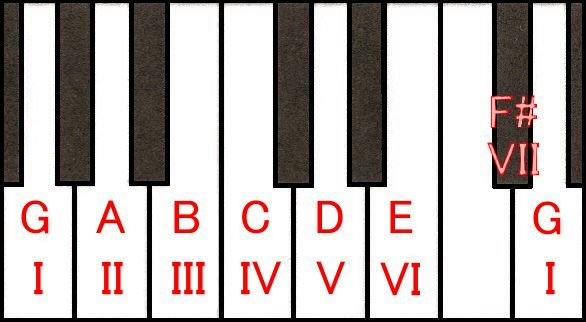
This is how they are organised on the piano keyboard –
The key of C
The key of G
So you can find chords I, IV and V by counting up the notes. You may be able to just work it out aurally by finding thee chords that feel right in each key. I think it’s useful to be able to do both.
The three chord trick in every Key
Key
I
IV
V
C
C
F
G
C#(Db)
C#(Db)
F#(Gb)
G#(Ab)
D
D
G
A
D#(Eb)
D#(Eb)
G#(Ab)
A#(Bb)
E
E
A
B
F
F
Bb
C
F#(Gb)
F#(Gb)
B
C#(Db)
G
G
C
D
G#(Ab)
G#(Ab)
C#(Db)
D#(Eb)
A
A
D
E
Bb
Bb
Eb
F
B
B
E
F#
A fantastic example of the three chord trick is ‘The Lion Sleeps Tonight’. The entire song uses the following chord sequence in a loop –
I
IV
I
V
If you know the chord relationships (as in the table above) you can play it in every key. This song is the subject for my next blog. I will add downloadable charts for it in a few keys, some with the corresponding ukulele diagrams.
We have only been talking about major keys so far. Minor chords are notated by roman numerals in the lower case, so in the minor key they would look like this: i, iv, V. The three chords have the same functions in the minor keys, only the dominant stays major in order to use the leading properties mentioned above and take us back to chord I.
Many songs use the three major chords and one minor chord. This is most likely to be chord vi (6). It is the most common chord after the three chord trick. An example of this is ‘Heart and Soul’, that piano duet you always learn from friends at school –
C
Am
F
G
I
vi
IV
V
All the songs in this brilliant video have this structure –
You can download the whole books in PDF form from the link above; a beautiful old book that has been scanned in. There are a few more notes in there, and it continues with several parts, all really lovely and fun to play. I had as much of a go at it as my toddler would let me (same helper as in the first Name That Tune video).
My guitar teacher friend said it’s on the syllabus of the Trinity examinations, so it is still very much a popular teaching piece after 200 years.
Here it is with the third part. If you have a look at the dots, there’s more!
We had a great time on facebook trying to find the right answer to last week’s Name That Tune. Finally it came from New Zealand. Thanks Jonathan for naming Winifred Atwell’s arrangement of the Twelfth Street Rag by Euday L. Bowman. Click on the picture to see the incredible Winifred Atwell playing the Black and White Rag and then the Twelfth Street Rag (12th Street Rag comes in at 1.30). I defy anyone to watch this and not smile.
It’s so interesting after all these years to hear what bits of what we played are actually the original tune, and what bits were fabricated by Grampy, or me, or more likely a bit of both.
We had some close guesses from my über mother friend; firstly the theme tune to Pot Black, which actually was Winifred Atwell playing the Black and White Rag, and then music for a Charlie Chaplain film, which is conformed when you look up the Twelfth Street Rag on Wikipedia. How does a mother of six and another one on the way have time to be a ragtime expert?
According to Wikipedia, here is the story of our mystery tune.
A friend of Bowman’s known only as “Raggedy Ed” declared his intention to open a pawn shop on Twelfth Street while the two were walking along it. Bowman is rumored to have said “If you get rich on those three balls I’ll write a piece on three notes to make myself rich”. The result was “The Twelfth Street Rag”, one of the most famous and best-selling rags of the ragtime era. It was more than 15 years before Bowman actually wrote the music down in manuscript form. He returned to Texas briefly and tried to sell the song to a company in Dallas, but only had an offer of ten dollars for it and was told it really wasn’t worth publishing. Returning to Kansas City, he sold it to Jenkins Music Company in 1913. The Jenkins company felt Bowman’s arrangement was too difficult and hired C.E. Wheeler to simplify it. With a big advertising push, “Twelfth Street Rag” began to sell better. In 1919, James S. Sumner added lyrics. It was popular with the early Kansas City bands and became a huge hit after Bennie Moten recorded it for Victor in 1927. It has since become an enduring standard of jazz.
I reckon if the three balls story is true, Bowman might have already been thinking of
his three note tune before he said it. Harry, my Granddad would have been seven years old when this tune became ‘a huge hit’. Wikipedia also has this little nugget of information-
More recently,a ukulele version has been featured as background music on the TV series SpongeBob SquarePants.
Here is a PDF of the sheet music, in Eb (as opposed to our key of C) and using, hmm, a couple more notes than the version me and Grampy played.
Now. On to mystery tune number two. This week we have a classical guitar piece to solve. A pupil’s mum played it to me one lesson, she had learned it years and years ago, it was the only thing she could play on the guitar, and had no idea what it is and where it came from. Neither did I! Can anyone name this tune? It’s pretty and is easy for beginners.
I have decided to start a blog mostly around music and music teaching. This week I have been teaching someone to play ‘A Nightingale Sang in Berkeley Square’ on piano and ukulele, arranging the Harry Potter theme tune for piano; chords in the left hand, for a precocious 6-year-old, arranging and rehearsing a two part version of the spiritual, ‘Down in the River to Pray’ for a talented brother and sister who are going to sing this unaccompanied at their grandma’s funeral. As I continue to amass teaching material tailored to each student I will make them available for download on this blog.
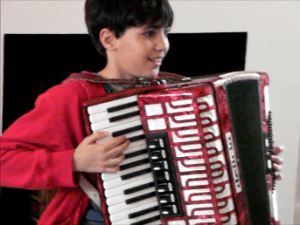
The lesson that has made me most itching to blog since I thought of doing this was on Monday. I have two pairs of siblings for whom I am not the only piano teacher. The other teacher takes them through grade exams and all the more formal aspects of learning, and I’m required to make sure music is still fun. Lucky me! We do lots of improvising and playing around with chords, learn music from films and computer games. The brother from the Monday house also has an accordion. It’s half the size of him and even heavier than mine and he has to play it sitting down, but he perseveres.
He was really excited to show me that he has started learning ‘The Entertainer’ on it. I like to give him chance to practice each hand separately so while he plays right hand I vamp the chords on the piano, and when he tackles the chord buttons I play the tune. It sounds great on accordion and jamming it with Paul took me right back to playing it with my grandfather when I was a kid. And then I was struck by the thought of the fantastic skills that my grandfather gave to me, teaching me tunes like The Entertainer by ear.
Grampy never learned to read music and just soaked up everything he heard like a sponge. From an early age he taught me tunes by rote, and then chords and how to apply them. It was so early on for me that I soaked it all up in turn from him and can’t really remember learning it in the first place; only I remember him explaining 7th chords to me, because instead of (for example) ‘G7’ he always said, ‘G to the 7th’, which made it seem very mysterious! When I play the things I learned from my Grandpa, it sounds so similar to my memories of his playing that it feels a little like I’m recalling him back to life.
One of my favourite tunes he taught me is ‘Ballet Egyptien’. He learned this the day that two pianists came to his school when he was a small boy. They made a lasting impression on him and he worked a version of his own out on the piano, and years and years later, passed it on to me.
Grampy was fond of all different styles of music and didn’t see any boundaries between them. He was just filled with a passion for music and the delight of trying to replicate the sounds that he heard. He would go from folk tunes to trad jazz to musicals to opera tunes to cockney knees up without batting an eyelid, but his favourite music of all was calypso and African music; the the chord progression he called ‘kwela’ which he loved playing in ‘The Lion Sleeps Tonight’.
However sponge like his ears were for melody and harmony, the same could not be said for lyrics, and as he strummed the guitar would always, whatever the song, sing the words ‘bim bam bo’ or similar. Another result of this soaking up of music but no words is that he had a huge catalogue of tunes in his head with no titles. (maybe catalogue is the wrong word for it). I have inherited these. I play tunes and haven’t the foggiest what they are. So I’m hope the cyber community will help me out and name that tune. It sounds like it’s quite a famous tune, so I think somebody will know. Here it is, videoed on my phone today, with the help of my kids.

 I was asked for the notes of the Peppa Pig theme tune. As this is one of the most frequently heard tunes in my house at the moment, this was not a problem!
 My students and I had our fifth Big Fat Music Party the other evening. I came up with the name as I was trying to get away from the formal idea of a ‘concert’, a word bound to strike fear into many a sensitive heart. After all, it’s a bit of a shame if as a learner of piano you always play on your own until you then suddenly have to perform in the spotlight in front of a silent audience (or have to be judged by an examiner in a grade exam, but that’s another chapter!) The Big Fat Music Parties are held in the front rooms of the families of my students, and from the first one, they have had a relaxed atmosphere of camaraderie and fun.
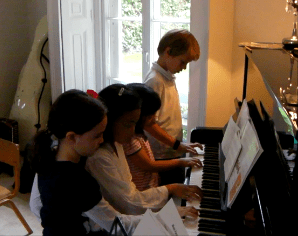 I try to get people playing together as much as possible. In the first one all the smaller pianists made up different verses to ‘What Shall We Do with the Drunken Sailor?’ and each of them played their verse while the ukulele and guitar students, my accordion student, random percussionists and me lower down on the piano held the rhythm.
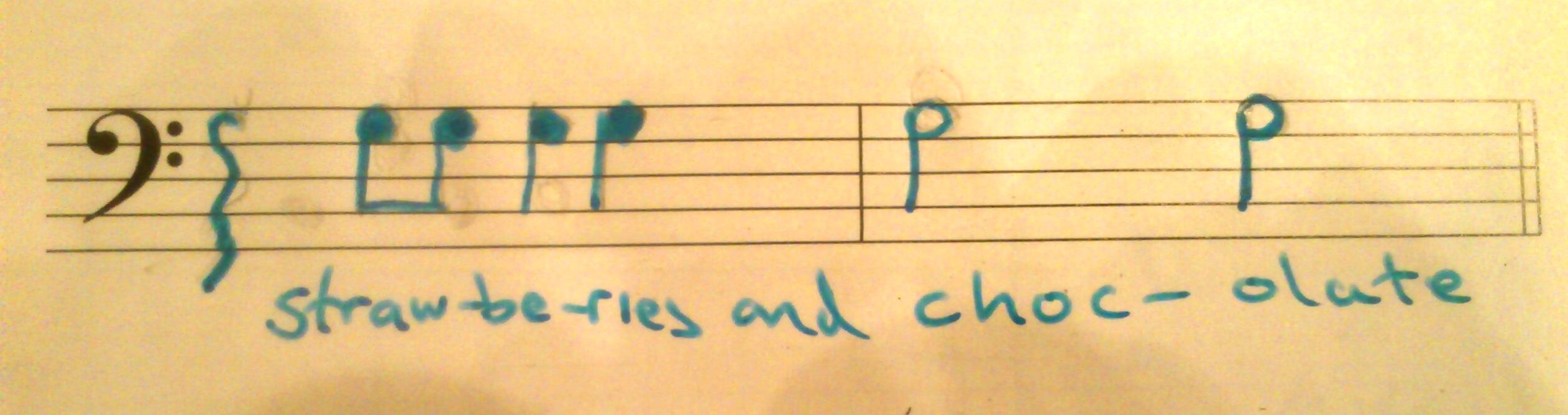
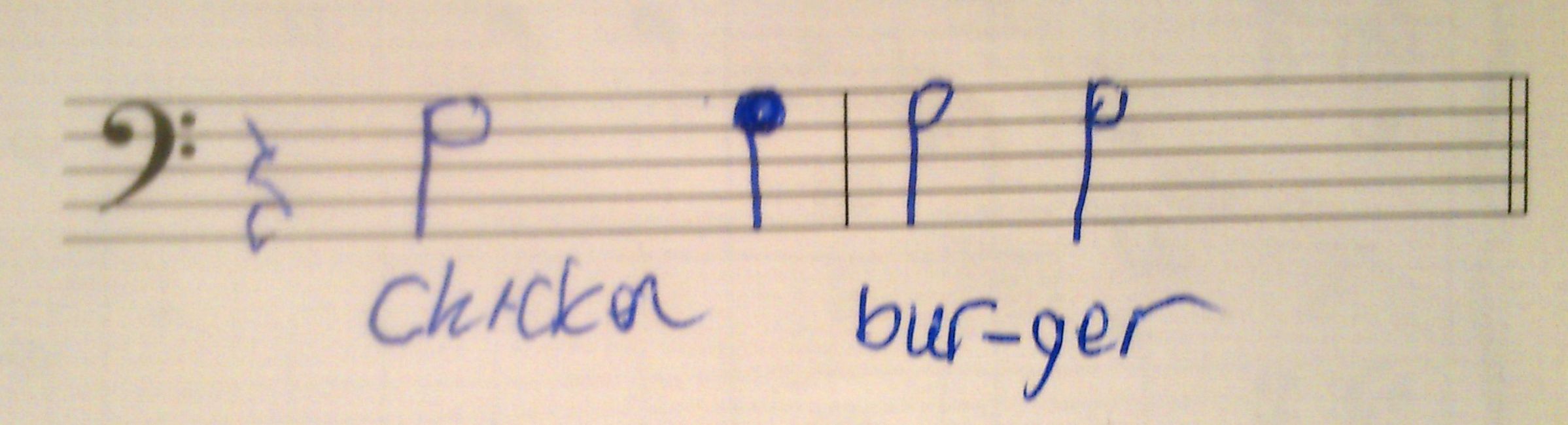

 avocados’ which we played in the minor key and sadly, instead of
  ending with ‘eat them all straight up,’ we sang, ‘throw them all straight up’. (Sorry avocados, not my opinion).
 Music Party where everyone had to play something from a movie, show, TV programme or video game. We divided the room into two teams and they had to guess which of these things each piece came from. I hadn’t expected it to get so competitive! We had Somewhere Over the Rainbow, Pink Panther, When I Grow Up from Mathilda, music from Plants Vs. Zombies to name a few.
 tive the children in the audience were, listening to their fellow students play. Although having said that, some of the very competitive ones, when they thought they had the answer could barely restrain themselves until the end of the piece! The teams were most of the time neck and neck. The people on the beanbags at my feet were increasingly whipping themselves into a frenzy, writhing contortedly with their arms in the air and singing along ecstatically to the final song, Skyfall. At the end, a final count-up of the stars on the chart to my great relief revealed a tie, at which I announced that everyone had won and what they had won was the enormous pile of biscuits, cakes and sandwiches laid out for us on the table. Phew!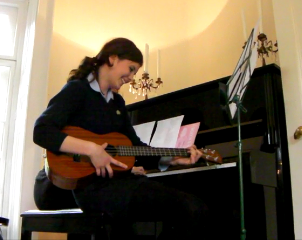




 Conrad's Chords