Scarborough Fair

Chords, modes, feisty lyrics and endless variations

Downloadable PDFs of Scarborough Fair: Tune line, chords and full lyrics.

Scarborough Fair in Dm (the key in the LCM book)

Scarborough Fair Am (our key)

Scarborough Fair Em (Simon and Garfunkel’s key)

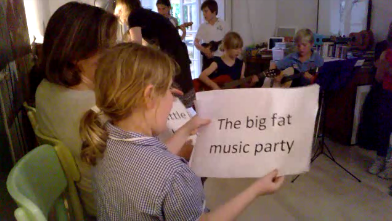
One of the highlights of my summer Big Fat Music Party was the family of four who sang and played Scarborough Fair.

LCM1Our interest in this song was sparked by an arrangement of it by Wild in the son’s LCM grade 1 piano book. It’s a nice arrangement which sounds lovely as a solo piano piece, but we soon found we wanted to get to know the bones of the music and understand it, so we were quickly off the printed page, looking at the chord structure underneath the melody, singing the words and making our own arrangements.

As with a lot of folksongs, the key isn’t really minor or major, it is modal; it’s in the dorian mode. The scale has a minor 3rd, a major 6th and a minor 7th, which when you’re starting on D, works out as all the white notes.
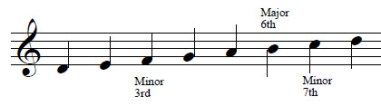
Dorian D

Dorian mode is a great scale to encourage students to play around. I usually play a jazz waltz like accompaniment – and they can freely play any white notes on top of that.

Dorian Accompaniment

It’s great because they can’t hit a wrong note, so they are free to experiment and let their ears guide them. We do a bit of trading phrases too, and I just keep the accompaniment going in the left hand.

We explored how you can harmonise the melody with block or broken chords in the left hand.

The daughter of the family who has developed a love of singing lately got in on the act and we transposed it from D to A Dorian, which is a little more palatable to sing.

Now we could experiment with A Dorian, which has one black note, F#, on the major 6th.
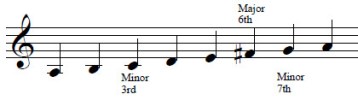
Dorian A

Because this is Dorian rather than minor, you have a D major chord in the harmony rather than D minor, because of this sharpened 6th (F#) in the scale. It gives it that wonderful old-world feel, as these folk songs are from a time before major and minor modality took off.

The dad is learning guitar, so he accompanied with a nice um cha cha strum.

Scarborough fair chordsNotice the irregular bar structure. Folk songs often have this fluidity about them, as they would likely be sung by an unaccompanied singer.

This isn’t the only way to harmonise this, by the way. It’s the one that suited us best at the time. There are so many variations you could choose, just experiment and find which chords you like best.

So at the party, on the piano we had the mum on broken chords in the bass and son on the tune, dad accompanying on guitar and daughter singing.

I loved the way the son kept something which he liked from that initial arrangement; an echo of the last phrase which softly plays out, beginning on the singer’s last word. I got all the other players to stop on this last word, so the echoing phrase meandered on its own, over the ringing out of the final chord. He milked it well too. Nothing like a playful ending to captivate an audience, and leave them with a good memory of the piece!

Lyrics

Now this was really interesting. I had grown up with the Simon and Garfunkel version which is beautifully ethereal, has an anti-war poem of Simon’s woven in as a counter melody, five verses and doesn’t appear to make a whole lot of sense.

A quick trip to Wikipedia showed me older versions with a lot more verses, and the song being a dialog between a male and female singer, where basically he says she can be his lover if she performs a series of impossible tasks, and she returns with a pretty neat comeback!

Male part:

Are you going to Scarborough Fair?
Parsley, sage, rosemary, and thyme;
Remember me to the one who lives there,
For once she was a true love of mine.

Tell her to make me a cambric shirt,
Parsley, sage, rosemary, and thyme;
Without any seam or needlework,
Then she shall be a true love of mine.

Tell her to wash it in yonder well,
Parsley, sage, rosemary, and thyme;
Where never sprung water or rain ever fell,
And she shall be a true lover of mine.

Tell her to dry it on yonder thorn,
Parsley, sage, rosemary, and thyme;
Which never bore blossom since Adam was born,
Then she shall be a true lover of mine.

Female part:

Now he has asked me questions three,
Parsley, sage, rosemary, and thyme;
I hope he’ll answer as many for me,
Before he shall be a true lover of mine.

Tell him to buy me an acre of land,
Parsley, sage, rosemary, and thyme;
Between the salt water and the sea sand,
Then he shall be a true lover of mine.

Tell him to plough it with a ram’s horn,
Parsley, sage, rosemary, and thyme;
And sow it all over with one peppercorn,
And he shall be a true lover of mine.

Tell him to sheer’t with a sickle of leather,
Parsley, sage, rosemary, and thyme;
And bind it up with a peacock’s feather,
And he shall be a true lover of mine.

Tell him to thrash it on yonder wall,
Parsley, sage, rosemary, and thyme,
And never let one corn of it fall,
Then he shall be a true lover of mine.

When he has done and finished his work.
Parsley, sage, rosemary, and thyme:
Oh, tell him to come and he’ll have his shirt,
And he shall be a true lover of mine.

And finally, as a Dylan fan of old, I can’t mention Scarborough Fair without mentioning the equally if not more beautiful, ‘Girl from the North Country’, one of the songs Bob Dylan wrote which was directly inspired by a folk song, using some of the form and the lyrics to create something with a feel that is new and old all at the same time.

Posted in charts, Ensemble, guitar, music teaching, piano, sheet music, singing, theory | Tagged , , , , , , , | Leave a comment

Pentatonic in 3

This duet is a firm favourite, and one of the first I wrote. Although it is the only one to venture out of the five-finger position, it is actually one of the easiest. I generally introduce it second after Breeze. It’s great to get them reading and feeling three-in-a-bar this early on.

The two pianists get to swap around with each other, taking turns to play the tune, and a high drone on A (the 5th note to complete the pentatonic scale).

The Intermediate part is swung; play it nice and lazily. It may initially seem like a lot of notes, but it consists of the same pattern repeating, so once you get your head around the pattern, it’s all yours.

The beginner part repeats a very simple pattern, but sounds different when it comes round again, because it is harmonised differently by the intermediate part. The harmonisations are quite jazzy and sometimes a bit adventurous, I suspect a bit too adventurous for one particular Amazon reviewer, but stick with it, you will be rewarded when it all comes together!

Enjoy.

This video was taken at the Music Education Expo 2015. This lovely music teacher I had just met is sight reading the beginner’s part. I rather like the ambient sounds in this one!

And now sans ambience.


Posted in piano, piano duets | Tagged , , , , , , , , | Leave a comment

Allegro

Now that I have recorded all of my Delightfully Easy Duets with the unstoppable Rei Kozaki, I have been meaning to feature a different duet each week.

So here is Allegro, duet 1 from book 1. It has an upbeat, sunny feel, with a bit of an echo game going on between the two parts.

These duets were written specifically for maximum ease, and this one is particularly easy for the intermediate secondo part.

The beginner’s part is always in unison throughout the two books, so that the beginner can experience coordination between the two hands without having to think of two different ideas at once. In Allegro, the intermediate part gets to play with both hands in unison too, so they can relax and enjoy the interplay between the two parts.

There is a faster rhythmic figure which gets passed between the players, which always has a crescendo and diminuendo. I would advise players to see if they can outdo each other on these swells of dynamic. And don’t pause at the end of the lines. Think ahead and keep going!

Posted in piano, piano duets | Tagged , , , , , , | Leave a comment

Mixing it Up: Two Tunes in One

Happy New Year everyone!

I thought I’d kick off 2016 with two tunes: a really old tune and a brand new one that fit together perfectly. I’m lucky enough to attend a folk music workshop with Laurel Swift one evening a week. We learn a new tune every time. One of the tunes I love for its simplicity is the Welsh tune, Pwt Ar y Bys, or Buttered Peas. Someone at the workshop mentioned they’d like the group to play two tunes simultaneously which fit together. I thought I would have a go at writing a tune that would fit with one we already play, and chose Pwt Ar y Bys. So here is my tune, Buttered Scones.

These two tunes are great to play together in a group instrumental lesson, or just between friends for fun. They are easy and enjoyable in their own right, and create a great ensemble piece when put together. Laurel added a third part; a drone (just one note, D in quavers all the way) which sounds great. Here are the unstoppable West London Folk Band (our weekly workshop group) playing this, then launching into a new time signature for a third tune, Barney Bralligan’s. Spot our illustrious leader break into a clog dance for the grand finale of the concert!

Magic can happen when you look beyond the dots and treat music like ingredients. Mix things up, try things out, see what delights you can cook up!

If you’re interested in folk tunes, the blog for Laurel’s workshops is a great one to follow. All the tunes, old and new which we learn each week are put up in the form of notation and a video so you can hear it.

Also well worth a visit is Jenny Glover’s Fiddletails where Jenny delves into her considerable knowledge of folk tunes, especially American old time, and comes up with some real gems.

Posted in Ensemble, Fun, music teaching, sheet music, violin | Tagged , , , , , , , , | Leave a comment

Workshop Day! Using Harmony Right fom the Start

The infinite benefits of Um Cha and Um Cha Cha

A few Sundays ago I attended the event, Casio workshop for Piano Teachers in Waterloo. It was great to share some of my teaching ideas and techniques with the group and demonstrate how I use these with my book, ‘Fun, Games and Party Pieces‘.

I was demonstrating how to teach chords right from the beginning, and using ‘um cha’ and ‘um cha cha’ to accompany all the pieces they are learning. This is fun and rewarding for the student, as they are making a big sound and they are on a level musically with the teacher. They are also internalising the harmonic structure and pulse of the pieces they are playing. This is happening naturally through the practical experience of playing rather than an intellectual exercise. The handout I made for the workshop detailing the steps I use to teach chords to beginners can be downloaded here.

Casio Piano Teacher workshop handout – Using harmony right from the start

I had fun showing the teachers how to do this with the chord diagrams for the tunes in Fun, Games and Party Pieces. Here’s a volunteer playing Um Cha using the chord diagram to ‘Mix it Up’, and me with two volunteers playing a trio version of ‘Three Tunes in Three’.

I played through some of my duets with the piano teachers which is always good fun, and I thoroughly enjoyed being in the audience for the rest of the day. Highlights for me were as follows:-

  • Composer Heather Hammond demonstrating the circle of 5ths in a minor key and then breaking out into a rousing rendition of ‘I will Survive’.
  • Hearing the sound of a grand piano being played in Notre Dame cathedral from a small digital piano.
  • Physiotherapist Drusilla Redman asking the audience to describe the feeling of performance nerves, and then getting us to recall how it feels when you fall in love. Light-headedness, sweaty palms, racing heart… ‘Did you like the feeling?’ She asked. The response was a definite ‘Yes’. So what happens to you when you fall in love is the same stuff that’s going on when you have performance anxiety. The difference is how we view it. What a useful and liberating comparison!
rosa and naomi

Sitting among Heather’s and my books with the lovely Naomi from Solemate.

A big thanks to Lorraine Liyanage from SE22 Piano School for organising this great day.

Posted in Fun Games and Party Pieces Beginner, music teaching, piano, theory | Tagged , , , , , , , , | Leave a comment

Casio Workshop for Piano Teachers

Come and see me and get in for cheap!

Fun-Games-Front-CoverSince Launching Fun, Games and Party pieces I have been really pleased with how versatile it has proved to be in my own teaching. I added chord diagrams to each tune for family members to play along on different instruments, or teachers who like to work with chords like me.

The book functions well enough as a collection of fun pieces for beginners, but also has real scope for opening up the world of harmony for teacher and pupil alike, starting a journey that will ensure a deeper understanding of all the music the student will encounter in their future.

There are so many things you can do with these chord diagrams, giving students the ability to use chords, harmonise and understand harmony right from the beginning.

Excitingly, I’m going to get a chance to demonstrate these techniques in the Casio workshop for Piano Teachers this coming September.

I am looking forward for this chance to show other teachers how I use my own music in my own lessons, but also I’m really looking forward to being a part of this all-day workshop.

I’ll get the chance to learn about using digital technology in lessons to great effect, try out the latest digital pianos, hear straight from the composer of ‘All That Jazz’ about teaching Jazz and other modern styles, get help with how to promote the best posture for my students, find out how to run a ‘practice-a-thon’ and try out the new elegant and versatile footstool for young pianists.

Come and join me! The organiser has very kindly allowed me to offer a discount to my friends. Click the link below to enjoy a discounted rate of £24.99 for the whole day.

piano workshop discount

Posted in Fun Games and Party Pieces Beginner, music teaching, piano | Tagged , , , , | 1 Comment

He’s Got the Whole World in His Hands

I recently realised that ‘He’s Got the Whole World in His Hands’ would make a wonderful two-chord song for beginners and wondered why I hadn’t thought of it before.

worldIt was a song we sang at school right at the start. Reception age, when memories begin. I have memories of other songs from that time, I’m a little teapot, I quite liked the gentleness of Kumbaya. In particular I have a strong memory of finding the tune of ‘If You’re Happy and You Know It’ moronic and feeling very disgruntled at being made to sing this and clap my hands in affirmation whether I actually felt happy or not. (I never did like ‘forced jollity’ and I suppose this song is the embodiment of that!)

I really was happy when we sang ‘Whole World’, and that feeling as a small child is what I associate the song with. I don’t remember it that clearly, but I remember loving it. There’s something about the rhythm that sets it apart from other songs, something that forces you to swing it and move like you’re in a gospel choir.

Put all that with the fact that the structure is easy to grasp instinctively and only uses two chords. A perfect recipe for happy music-making.

This is the structure throughout-

Whole world table   –  or  –

whole world harmony(see an explanation of harmony writing here)

At my last Big Fat Music Party, we played it as a group in C to suit the piano and ukuleles, and the guitars played it in A with a capo on the 3rd fret. Here are the charts –

He’s Got the Whole World in His Hands uke

He’s Got the Whole World in His Hands guitar

The pianist played ‘um cha’ on C and G –
um cha c root          um cha g inversion 1
(She loves playing this to accompany herself singing).

Because of the gospel feel, I took this opportunity to get people to practice clapping on beats 2 and 4, to the right and then the left. A great exercise which lightens and brings music to life, rather than the dull, lumpy clapping on 1 and 3 which seems to come naturally to us white Europeans, I’m afraid!

There are various different verses, I have put a selection of popular ones in the charts. You can always make up your own. Nina Simone sang, ‘He’s got the gamblin’ man in his hands’ in her achingly beautiful slow chordal version with the sublime descending basslines. Not a two chord version, that one. It changes chord on every beat. I was once asked to write down all the chords to this version, so you can have it too.

He’s Got the Whole World in His Hands Nina Simone version

Posted in charts, guitar, piano, singing, ukulele | Tagged , , , | 1 Comment

Mairi’s Wedding

Mairi’s Wedding is a gorgeous folk song that is a real delight to sing and play. I chose it as one of the numbers that everyone would play together in my most recent Big Fat Music Party because of its beautifully easy chord structure. It consists of the following three chords which repeat throughout the song. We played it in D, which was a good key for all our instruments and voices.

Mairi's Wedding table
Mairi's Wedding harmony table(see an explanation of harmony writing here).

Here is the sheet music, tune line and chords-

Mairi’s Wedding

On the day we had two Guitars, two ukuleles, three people on the piano (one playing chords, two playing the melody) one fiddle, a few percussionists and lots of singers.
My great violin-playing students (I normally teach them piano) who are brother and sister couldn’t make the party, but when we were working on Mairi’s Wedding in their lesson, they came up with this brilliant easy double stopping accompaniment based on the rhythm of the first two bars. It sounded great when they played it together (one on tune, one on accompaniment, then swapping over).

Here it is-Mairi's Wedding fiddle harmony

I love that the D never alters even on the A chord, creating a compelling drone.

Before the party I videoed some of the lovely West London Folk Band (led by the brilliant Laurel Swift) playing the song so that my students could listen to it in the week.

Here is our rendition at the party-

Posted in charts, guitar, music teaching, piano, sheet music, singing, theory, ukulele, violin | Tagged , , , , | 1 Comment

Pick a Bale of Cotton

The group tunes for this term’s Big Fat Music Party were all tunes recently rediscovered from my past. ‘Pick a Bale of Cotton’, a work song from the deep south made famous by Leadbelly, is a great one that I remember singing in a guitar group I used to attend as a child.
It is a two-chord song which can be played with one chord if necessary. Very repetitive and quite addictive to sing!

The chord structure consists entirely of the following four bars repeated.
Pick a bale table

We played it in E to suit the guitarists but you can easily put it in any key. It uses chords I and V. The key of C is good for ukuleles and the piano.

Here are the charts:-

Pick a Bale of Cotton in E for guitar

Pick a Bale of Cotton for in C ukulele

E is possibly the worst key for the ukulele, so I tuned the older players’ ukes up into D tuning (A D F# B) and they played it with D and A7 shapes. For the tinies, I tuned their ukuleles to an chord of E (G# lowB E highB) so they could strum freely. It sounded rich and banjo-like.

I recommend teaching the song with one chord at first, and then adding the second when they can play and sing it fluently.

This is a good simple ‘um cha’ pattern for the piano – um cha

We played it in E, so I gave our pianist a super easy version –
um cha E

When planning to get people together to create a band on the day, it’s essential to give them things to do that are easy enough for them to play without much effort so they can listen to what’s going on around them as they play, and react with other band members.

This song is great fun as you can make up your own verses. Children love it when you insert their name into the verse. (‘Me and ____ can pick a bale of cotton). For the party I randomly chose student’s names and had them printed big in advance for a bit of a surprise element.

Here is our raucous version-

And here is Leadbelly’s. I notice now that he speeds up, singing each verse faster and faster. I’ve GOT to do it this way next time!

https://www.youtube.com/watch?v=ChYeb8ACjqw

I also had this picture printed up large to show everyone, and explained how each tiny bit of cotton had to be picked by hand from the flower. This is how big a bale of cotton actually is.

bale of cotton

Puts life into a bit of perspective, eh?

Posted in charts, guitar, music teaching, piano, singing, theory, ukulele | Tagged , , , , , , , , | 1 Comment

End of term = Big Fat Music Party!

whole world 2I held my 7th Big Fat Music Party the other week. These are my concerts that don’t feel so much like a concerts. I want to get away from the feelings of dread which seemed inseparable from performing to other people when I was growing up.

I try and encourage as much collaboration between students as I can. It is great to find well known songs where the chord sequence goes round in a loop throughout. In the past we have had great fun with ‘The Lion Sleeps Tonight’. This time we had three new numbers like this where everybody could join in. I have written a blog about each one with ideas and downloadable charts.

mairi's wedding 3

He’s Got the Whole World in His Hands

Pick a Bale of Cotton

Mairi’s Wedding


Apart from the group numbers, here are other things which create a relaxed feel and engage the audience:-

  • Hold the event in someone’s  home. I initially asked the parents of some students who had a nice piano and large front room, and after that first one I had lots of offers from parents to host it at theirs.
  • Have chairs around the edge for the adults and cushions on the floor for the children. This sidesteps the formality of rows of chairs and allows the young students to bond.
  • Make younger siblings welcome. Let them dance and clap. Give them percussion for the big numbers.
  • Ask quiz questions about the pieces being played. This started when I once noticed that a lot of my students were learning music from film and TV, so we held a grand Big Fat Music Party film quiz. I was amazed at just how much this increased audience attention! Now I throw in a question here and there about the music we’re listening to. It engages and relaxes them at the same time. Hooray!
  • Get people to bring snacks so we can all have a good old nosh-up and chat afterwards. Quite often at this point a few children wander back to the abandoned piano and play music together.

amberI must say that probably my favourite aspect of the parties is watching the connections form between my students and their families. I see my students getting to know each other and bonding over their common subject – music. They see the friends they met before, make music together, and get to hear what each other are playing. This is so important. Music should not be a solitary occupation for children. How could that possibly succeed?

archie 2

Posted in guitar, music teaching, singing, ukulele, violin | Tagged , , , | 1 Comment